|
This chapter’s central theme is the human being, the one who is able to hear God’s message. People do not hear this message as mere information about God, unrelated to their lives. No, they hear it, explicitly or inexplicitly, in every experience. In fact, Rahner says that this is what makes us human. We have been created with the ability to encounter the transcendent God in the experiences of daily life.Chapter I sets out to explain this encounter and what makes it possible. The chapter has six sections. In the first part, Rahner shows that the philosophic analysis of human nature is interwoven with a theological reflection. In essence, he says, the human being is capable of a relationship with God. To ask about human nature, its capacity and its proper end, is ultimately a theological question. |
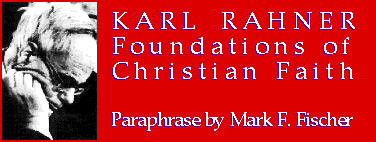
Photo of Rahner by Adolf Waschel of Vienna, scanned from the cover of Karl Rahner, I Remember: An Autobiographical Interview with Meinold Krauss, translated by Harvey D. Egan, S.J. (New York: Crossroad, 1985). |
.gif)
In the second part, Rahner defines the hearer of the message as a person and as a subject. The word “person” means that the hearer cannot be reduced to a mere product of the forces that have shaped him or her. No, the hearer is capable not only of listening, but of freely responding. The word “subject” also has a technical meaning. Subjects are human beings capable of reflecting on themselves. They can ask themselves who they really are, and about what is their true self.The third part states that the hearer of the message is a transcendent being. Hearers recognize that they are limited. But in that very recognition, they begin to imagine how they might surpass their limits. That is the first step to actually transcending them.Part four describes the hearer of the message as responsible and free. Every person can ask whether one choice is better than another, and make that choice. Whenever we do so, we take responsibility and act freely.Part five links the hearer of the message to salvation. People who recognize their limits begin to imagine how they might transcend them. Transcendence presents them with choices. When they choose the better alternative, they are not only acting freely and responsibly. They become agents of salvation. They are realizing what God has called them to be.In the sixth part, Rahner acknowledges that the hearer of the message is a dependent being. Even the free person is limited by time and place. We can envision only the possibilities that history has put at our disposal. Yet even in this limited and dependent way, the human person experiences spiritual freedom. We human beings are able to hear a message and freely respond to it. The message invites us to become what God means us to be. |
Part 1: The Interlocking of Philosophy and Theology
(I.1, p. 24). There is no philosophy that is absolutely free of theology, says Rahner. Whenever we say, “One person is capable of hearing another person,” we mean that God has created us with the ability to hear. Persons are shaped by history. In history Christianity confronts them, Christianity not just as an institution, but as God’s grace and message. So the philosophy that presumes that the human being is able to hear is not absolutely free of theology. In fact, it is an implicit theology.
And theology presupposes anthropology. Anthropology understands the human being as one created with the ability to hear God’s Word. This anthropology enables us to understand how the Christian message can be heard and understood. When Christianity encounters people, it encounters them as hearers. People who encounter Christianity can be asked, “Do you recognize yourself in what Christianity says?”
Part 2: Man as Person and Subject
(I.2, p. 26). In this section, Rahner defines what he means by “person” (A). This concept is essential, for Christianity is addressed to the human person. One needs to know what a person is, that is, to know the being with whom God speaks, in order to understand Christianity (B). And the chief characteristic of human “persons” is that they can put their very being in question, and so can transcend it (C).
A. Personhood as Presupposition of the Christian Message
(I.2.A, p. 26). When we Christians speak of the human being as a “person,”
we mean something specific. We mean that the human being is capable of transcendence,
responsibility, freedom, honesty in history, openness to mystery. The Christian
message presupposes that its hearers are people with these capacities –
in a word, are persons.
B. The Hiddenness and Risk of Personal Experience
(I.2.B, p. 27). In the personal experience of hearing God’s Word, the
Word remains hidden. It is implicit in, for example, the Bible, dogmatics,
ecclesiology, but not contained immediately in them. In them, God addresses
the Christian believers. They hear God’s Word in the media that we call
the Word of God.
When we say that, we acknowledge that we are saying something general about
the human being. We are creating a Christian anthropology. And like any anthropology,
Rahner’s is limited. In its general statements, anthropology attempts
to view the human being as the effect of this or that cause. It may even tempt
human beings to shift responsibility for their choices to something else –
to history, let us say, or to nature. But the risk of shifting responsibility
is worth taking. It is worth taking in order to say something about the human
being as a whole, something true, however incomplete.
C. The Specific Character of Personal Experience
(I.2.C, p. 28). The character of personal experience is this: we “have”
it in all that we do, but we do not always consciously reflect on it. In Rahner’s
anthropology, human beings experience themselves as “persons,”
as beings capable of transcendence. We are more than what a mechanistic anthropology
says we are. And it is precisely that “more” that Rahner invites
us to bring to conscious expression.
Once we recognize that we are products of history, psychology, etc., products of what is foreign to us, we then can put ourselves in question. We can ask about our true self. And that is what a “subject” is, namely, one who can put his or her very self in question.
The sciences tempt us to think that we can fully explain ourselves. But this is illusory. Transcendental experience suggests that I myself encompass every effort by science to explain me. The person transcends all attempts to reduce him or her to a system or to full comprehension.
To read the remainder of this text, please order the printed version of The Foundations of Karl Rahner by Mark F. Fischer, published in 2005 by Crossroad Publishing (ISBN 0824523423).
| Questions? Mark Fischer would love to hear from you. Send him email! MarkFischer@roadrunner.com |
To learn about the printed version of Foundations of Karl Rahner, Click here. |
For more information about Mark Fischer, select his name. |